

Air-Dried vs Freeze-Dried Dog Treats: What's the Difference?

Updated: Aug 22

ALPHA ACADEMY 🎓
LESSON 01
Air-Dried • Dehydrated • Freeze-Dried • Baked
Air-dried, dehydrated, freeze-dried and baked — you've probably seen all of these terms on dog treats. But what do they actually mean?
Welcome to the first lesson of Alpha Academy, where we're going behind the packaging and explaining what really happens to the treats we give our dogs.
Because when it comes to choosing natural dog treats, we think understanding what you're buying matters just as much as what's on the front of the packet.
Why are dog treats dried in the first place?
Fresh animal tissue contains a considerable amount of water.
Removing some of that moisture makes the finished product more stable and changes its texture, weight and shelf life.
But drying isn't simply a case of "taking the water out".
The temperature, airflow, time, starting material, final moisture level and water activity can all influence the finished product.
Water activity is particularly important because it describes how much water is available for microorganisms to use. It isn't quite the same thing as simply measuring the percentage of moisture in a product.
So when we talk about dried dog treats, there's more to consider than whether something feels dry.
What does "air-dried" mean?
Air-drying uses air movement, controlled conditions and time to remove moisture from the product.
As moisture moves towards the surface of the food, moving air carries that moisture away.
The process can gradually make a piece of meat, organ, fish or other animal tissue smaller, firmer and considerably drier.
However, there's an important point to remember:
"Air-dried" doesn't tell you everything about how a treat was processed.
The term alone doesn't tell us the exact temperature used, how long the product was processed, whether it received another treatment beforehand, or what the final water activity was.
That's why we shouldn't automatically assume that every product described as "air-dried" has been made in exactly the same way.
UK guidance for processed pet food recognises drying as one possible treatment, provided the method ensures that the finished product poses no unacceptable risk to public or animal health.
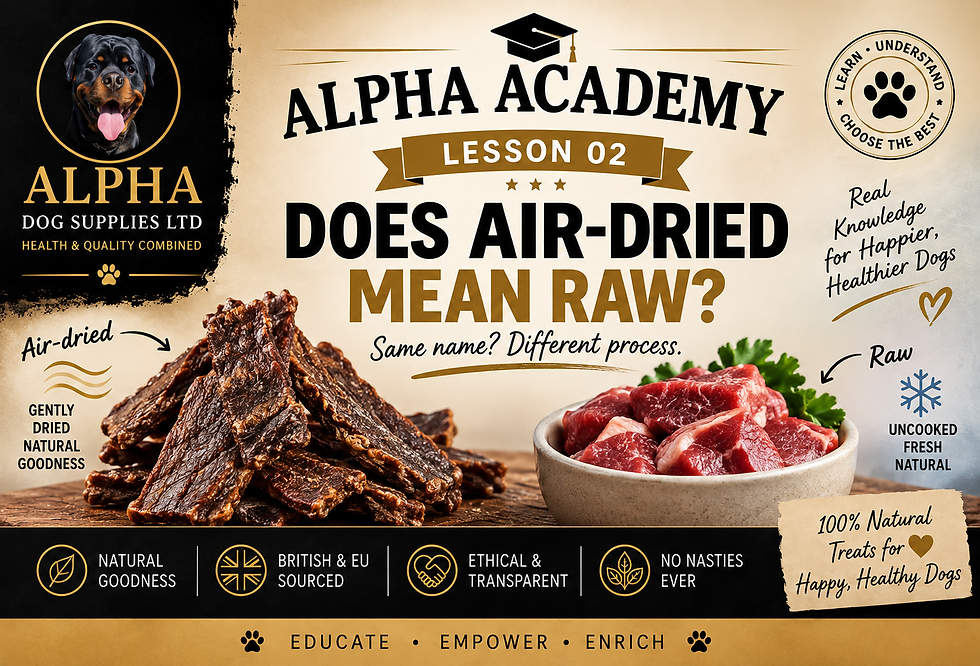
So air-dried does not automatically mean raw, nor does it automatically mean "never heated".
What is dehydration?
Dehydration also involves removing moisture from food, generally using controlled heat and airflow.
In everyday language, air-drying and dehydration can overlap considerably.
This is one reason we don't think it's particularly helpful to decide that:
"Air-dried = good"
and
"Dehydrated = bad"
The terminology alone doesn't tell us enough.
Instead, it's worth asking what actually happened during processing.
At Alpha, we'd want to know:
What ingredients were used?
Where did they come from?
How was the product processed?
What temperatures and times were involved?
Was anything added?
How was the finished product tested?
How was it packaged and stored?
The more transparent the manufacturer is, the easier it is for us, and you, to make an informed choice.
What is freeze-drying?
Freeze-drying is a very different process.
The product is first frozen.
It is then placed into a vacuum, where the frozen water can be removed as vapour through a process called sublimation.
The result is usually a very lightweight, dry and porous product.
Because freeze-drying removes water from a frozen product under vacuum rather than relying on conventional evaporation alone, the finished texture can be quite different from an air-dried or dehydrated treat.
Freeze-dried treats can also be particularly light because so much of the original water has been removed.
But, once again:
Different doesn't automatically mean better.
Freeze-drying is simply a different method of processing.
Whether a particular freeze-dried treat is a good choice for your dog depends on the product itself, its ingredients and how it has been manufactured.
What about baked dog treats?
Baking is another process altogether.
Instead of simply removing moisture from an individual piece of animal tissue, baking uses dry heat to cook the ingredients.
This is commonly used for biscuits, cookies and other formulated treats.
The baking process contributes to the characteristics we associate with a biscuit:
Crunch • Colour • Aroma • Texture
Baked treats can contain a combination of ingredients such as meat, fish, fruit, vegetables, grains or other permitted ingredients, depending on the recipe.
So comparing a baked biscuit directly with a single-ingredient dried piece of meat isn't necessarily comparing like with like.
They're different types of products made for different purposes.
Does "low temperature" mean a treat is better?
Not necessarily.
You'll often see phrases such as:
"Gently dried"
"Low temperature"
"Slow dried"
These descriptions may tell us something about the manufacturer's process, but they don't automatically prove that the finished product is nutritionally superior.
Processing can affect different nutrients in different ways, and the effect depends on the nutrient, ingredient, temperature, duration and overall manufacturing process.
So we'd rather not make a sweeping claim such as:
"Low temperature drying preserves all the nutrients."
Because that's much more complicated than it sounds.
What about safety?
This is an important part of the story, and one that can sometimes get lost when we talk about "natural" treats.
Natural doesn't mean that microorganisms can't be present.
Animal-derived ingredients can carry bacteria, including organisms such as Salmonella and Enterobacteriaceae, which is why processing and hygiene controls matter.
UK guidance requires sampling and testing of relevant processed pet food and dog chews, including testing for Salmonella and Enterobacteriaceae.
For dog chews, UK requirements also specify treatment sufficient to destroy pathogenic organisms such as Salmonella, together with precautions to prevent contamination after treatment.
The EU regulatory framework similarly provides requirements for processed pet food and dog chews, including treatments that ensure the product does not pose unacceptable risks to public or animal health.
So a properly manufactured dried treat isn't simply meat that has been left somewhere warm until it feels dry.
There should be a controlled process behind it.
So which process is best?
This is where we think it's important not to fall into the marketing trap.
There isn't one processing method that is automatically the best for every dog or every treat.
Instead, consider:
The ingredient — What is the treat actually made from?
The process — How has it been processed?
The finished product — How much moisture remains, and what is its water activity?
The safety controls — How has the manufacturer demonstrated that the product is safe?
The packaging and storage — How is the finished product protected from contamination and moisture?
Your individual dog — Is the texture, size, richness and chew level appropriate for them?
That's a much more useful way of looking at dog treats than simply deciding that one processing method is automatically superior.
What does this mean when you're choosing treats?
The next time you see:
AIR-DRIED
DEHYDRATED
FREEZE-DRIED
or
BAKED
on a packet, don't stop there.
Look beyond the marketing.
Read the ingredients.
Consider the product itself.
And, where the information is available, find out how it was actually made.
Because "natural", "air-dried" and "low temperature" are descriptions; they are not a complete quality assessment.
The Alpha approach
At Alpha, we're interested in more than simply finding a treat that looks good in a photograph.
We want to know:
Where did it come from?
What's in it?
How was it made?
What's been added?
How has it been handled and tested?
And if we don't know the answer to something, we'd rather say "we don't know yet" than make a claim simply because it sounds good.
That's what Alpha Academy is about.
Learn. Understand. Choose wisely.
Because we believe that knowing more about your dog's treats can help you make better choices for your own dog.
Alpha Academy 🎓
Because knowing what you're feeding matters.
Comments